

Notes
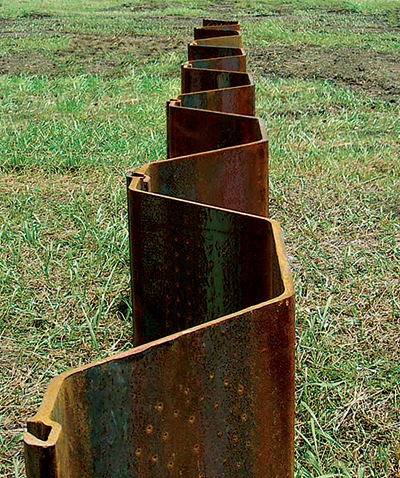
(Note 1) Steel sheet piles are a type of structural steel used for temporary earth-retaining enclosures at civil engineering construction sites. By driving the sheet piles into the ground at the planned construction site, a wall is constructed to withstand water and soil pressure, preventing the inflow, outflow, or leakage of soil, groundwater, and seawater.
(Note 2) "National land resilience" refers to the proactive development of a "strong and flexible" national land, economy and social system during peacetime ensuring the protection of human lives, preventing catastrophic damage to the economy and society, and enabling a swift recovery in the event of a large-scale disaster.
Solutions for "National Resilience" Against Natural Disasters
NIPPON STEEL CORPORATION
Industry: Manufacturing
| Updated | July 10, 2025 (Posted on July 10, 2025) |
|---|---|
| Publication date | August 19, 2024 |
| Sector | Natural Disasters and Coastal Areas |
Company Overview

The Nippon Steel Group, led by NIPPON STEEL CORPORATION, is Japan’s largest and the world’s fourth-largest steel manufacturer in terms of production volume.
Our Group operates in four key areas, with Steelmaking and Steel Fabrication as our core segments. This extends to Engineering and Construction, Chemicals and Materials, and System Solutions, leveraging the technology cultivated through steelmaking.
Climate Change Impacts
Climate change is causing rising sea levels, more frequent and intense extreme weather events, and an increase in powerful typhoons.
As a result, river and inland flooding, landslides, storm surges, and high waves are becoming more frequent and severe.
Adaptation Initiatives
Adaptation to climate change is seen as a business opportunity for the Nippon Steel Group. We contribute to the resilience of infrastructure against natural disasters such as extreme weather.
Below are some examples of our products:
●Steel Sheet Piles to Maintain Levee Function (Note 1)
We develop and provide a wide range of products and technologies for civil engineering applications.
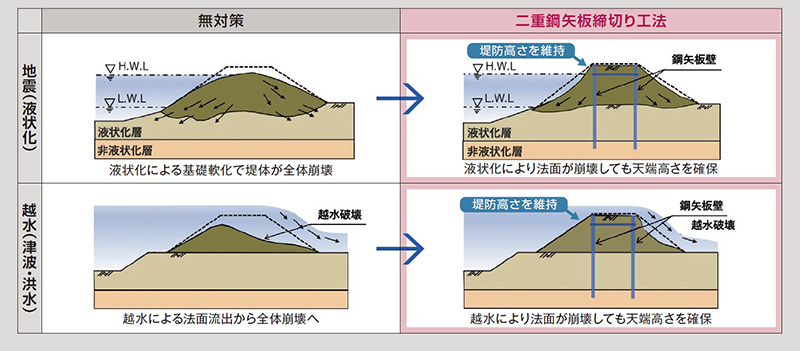
These include hat-type steel sheet piles, which contribute to national land resilience (Note 2) across a wide range of areas by addressing liquefaction and foundation leakage in river levees, as well as tsunami protection for coastal levees (see Fig. 1 and Fig. 2).
We also offer linear steel sheet piles, which have high tensile strength at the joints, making them suitable for circular structures such as cell-type quay walls, erosion control dams, and sealing works.
These piles help control erosion and prevent landslides during heavy rain and typhoons.
Furthermore, we provide settlement countermeasure techniques that utilize these steel sheet piles.
●Steel slit dams to prevent debris flow disasters
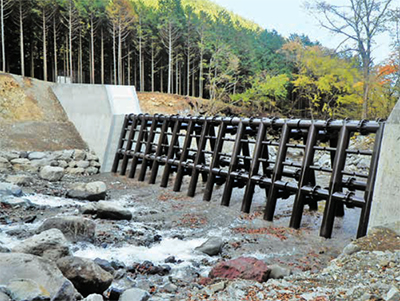
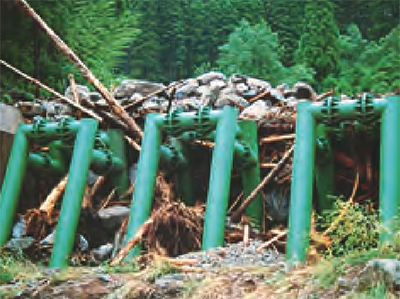
The "Steel slit dam Type AB" is installed in mountain streams or at valley outlets to capture large boulders and driftwood during debris flows, in order to protect human lives, property, and infrastructure in downstream areas (see Fig. 3 and Fig. 4). By not interrupting the natural flow of the river, it allows fine sand and sediment to pass downstream under normal conditions. This helps preserve the natural topography and the watershed ecosystem, providing significant environmental benefits. In Japan, the Ministry of Land, Infrastructure, Transport and Tourism and the Forestry Agency established a basic policy to actively adopt open-type check dams (steel slit dams) as a countermeasure against debris flows and driftwood, alongside warning and evacuation measures in 2018. As a result, these structures are now being actively implemented.
In addition to the products above, our Group is expanding its lineup of technologies and solutions that contribute to "national land resilience". We are also conducting proposal activities for government agencies (both national and local) and design consultants, and the Group's technologies and products are increasingly being adopted.
Effects/Expected Benefits
Our products are used as key materials for levees and other public infrastructures over the long term, contributing to provide "national land resilience" solutions. This help protect cities from floods, storm surges, and mudslides caused by torrential rains and typhoons, playing a vital role in disaster prevention and mitigation.
Related sites
- NIPPON STEEL CORPORATION
- NIPPON STEEL CORPORATION "Building Materials > Products List"
- NIPPON STEEL CORPORATION "Technology Illustrated: Nippon Steel Group's National Land Resilience Solutions Contributing to Disaster Prevention and Recovery" (only available in Japanese)
- NIPPON STEEL CORPORATION "Coping with Climate Change”
