

Footnotes
(Note 1) Rock bolt: A key component used to prevent slope collapse. It typically consists of a steel bar 20 to 30 mm in diameter, along with various accessories. The bolt is driven into stable ground, and the surrounding area is filled with grout to prevent a potential collapse of unstable soil or rock masses. To enhance the support effect, a bearing plate is often attached to the head of the rock bolt.
(Note 2) Slope modification: The process of trimming and cutting the slope to reduce slope height and steepness, typically done to improve stability or create space for construction.
NONFRAME™ Method: A Tree-Preserving Slope Stabilization Technique
NIPPON STEEL METAL PRODUCTS CO., LTD.
Industry: Manufacturing
| Publication date | November 25, 2024 (Posted on July 10, 2025) |
|---|---|
| Sector | Natural Disasters and Coastal Areas |
Company Overview

NIPPON STEEL METAL PRODUCTS CO., LTD. is a core subsidiary of the Nippon Steel Group and a leading manufacturer of building materials, specializing in steel products for the construction and civil engineering sectors. We have introduced numerous products that have improved social infrastructure, contributed to disaster prevention and mitigation, and enhanced traffic safety. As part of our mission, we ensure a stable supply of these products while continuously developing and promoting new solutions.
Climate Change Impacts
In recent years, climate change has intensified heavy rains and short, intense downpours across Japan. Furthermore, the development of cumulonimbus clouds, influenced by low-pressure systems, typhoons, and fronts, often leads to concentrated rainfall exceeding 100 millimeters within hours, increasing the risk of landslides.
Adaptation Initiatives
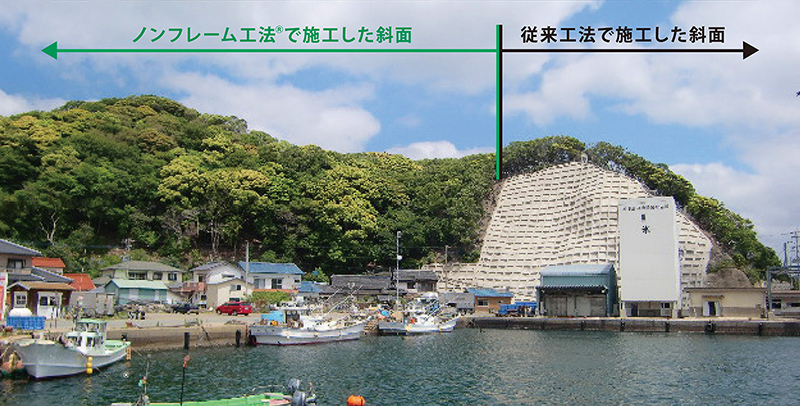
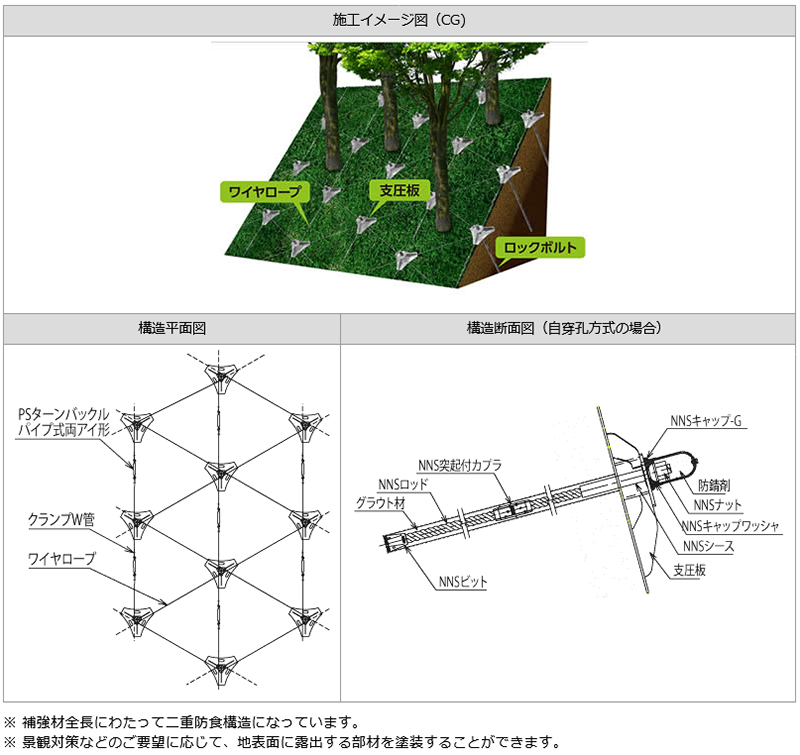
We have developed the NONFRAME™ Method, a slope stabilization system that involves utilizing 3- to 5-meter-long rock bolts to reinforce the slope (Note 1), while preserving the natural trees and greenery of the slope (see Fig. 1 and Fig. 2).
This innovative method, developed from the concept of how tree roots help stabilize the slope with minimal slope modification (Note 2), has the following features which distinguish it from conventional countermeasures.
- Landscape and Environmental Preservation
The system effectively stabilizes the slope while preserving the natural environment and biodiversity. By reinforcing the existing terrain, it mitigates erosion risks and enhances long-term stability, all while reducing CO₂ emissions. - Cost Reduction and Shortened Construction Period
Construction is carried out without altering the slope, eliminating processes such as tree felling, soil cutting, slope shaping, and vegetation work. Additionally, the use of secondary products —such as pressure-bearing plates— enhances the system’s structural integrity while maintaining efficiency in both time and cost. - Applicable Even Under Severe Field Conditions
1. No need for a wide access road
The NONFRAME™ Method installation can be done with small machines, allowing work in areas where establishing a loading road or staging area can be challenging.
2. Fewer restrictions on construction yards
Since this construction method does not rely on concrete, it does not require pumping equipment, allowing construction in small yards. There are no restrictions on height differences or distance from the construction site, although temporary facilities, such as a monorail, may be required. - Excellent Safety During Construction
For conventional methods, cutting into the slope can disturb its stability by releasing underground stresses and allowing rainwater to penetrate into the soil more easily.
The NONFRAME™ Method, on the other hand, can be applied directly to the existing slope, maintaining stability during construction. Furthermore, the use of secondary products, such as pressure-bearing plates, minimizes the labor required for steep slope work.
Effects/Expected Benefits
The NONFRAME™ Method makes it possible to protect slopes from disasters while preserving the natural environment and landscape. Its high environmental performance reduces ecological impact from multiple perspectives, contributing to a more sustainable countermeasure. For example, trees that were previously discarded after falling can now be preserved, reducing waste and contributing to global warming prevention through responsible use of forest resources. In comparison to conventional methods that rely heavily on reinforced concrete, this innovative system utilizes the steel’s properties to create smaller structures, significantly reducing resource use.
Related sites
- NIPPON STEEL METAL PRODUCTS CO., LTD.
- NIPPON STEEL METAL PRODUCTS CO., LTD.: “Non-Frame Method® for Disaster Prevention and Steel Structures"(only available in Japanese)
- NIPPON STEEL METAL PRODUCTS CO., LTD.: "Eco-Products for Disaster Prevention and Mitigation: Contributing to the Creation of a Safe, Secure, and Affluent Society"(only available in Japanese)
- NIPPON STEEL METAL PRODUCTS CO., LTD.: "Nippon Steel Group's Products and Construction Methods: Non-Frame Method® for National Land Resilience".(only available in Japanese)
