Notes
(Note 1) A superabsorbent polymer (SAP = Super Absorbent Polymer) is a polymer material designed to absorb multiple times its own weight in water. It retains water even under pressure and possesses various functions including water absorption, moisture retention, solidification, thickening, and controlled release.
(Note 2)・The manufacturing and disposal processes require significant energy and emit environmentally harmful gases.
・When mixed with fertilizers for agricultural use, its water-absorbing properties can be reduced due to chemical reactions.
・In agriculture applications or planters, excessive absorbency may draw moisture away from plants, causing them to wither and die.
・Lacks full biodegradability, leaving behind soil-contaminating residues and microplastics.
EF Polymer: A Superabsorbent Polymer That Enhances Soil Water and Nutrient Retention
EF Polymer K.K. Company
| Publication date | August 26, 2024 (Posted on Jun 19, 2025) |
|---|---|
| Sector | Water Environment / Water Resources, Agriculture, Forestry and Fisheries |
Company Overview

EF Polymer K.K. is a deep-tech startup founded in India and nurtured in Okinawa, Japan. The company upcycles orange peels and other agricultural residues that would otherwise be discarded, transforming them into EF Polymer, a 100% organic superabsorbent polymer. In collaboration with corporate partners, the company is also developing products using naturally derived SAP for applications in cooling agents, household goods, cosmetics, and more. Through the widespread adoption of its products, the company aims to address environmental challenges, with a particular focus on mitigating water shortages.
Climate Change Impacts
Worldwide, 45% of the total population is affected by drought, and the situation continues to deteriorate every year. Additionally, it is said that agriculture accounts for 70% of the freshwater available to humankind, leaving many farmers struggling with water shortages.
Even in Japan, a country considered to have abundant water resources, the recent climate change has led to an increasing number of regions affected by drought and irregular rainfall patterns, making the efficient utilization of resources even more crucial.
Adaptation Initiatives
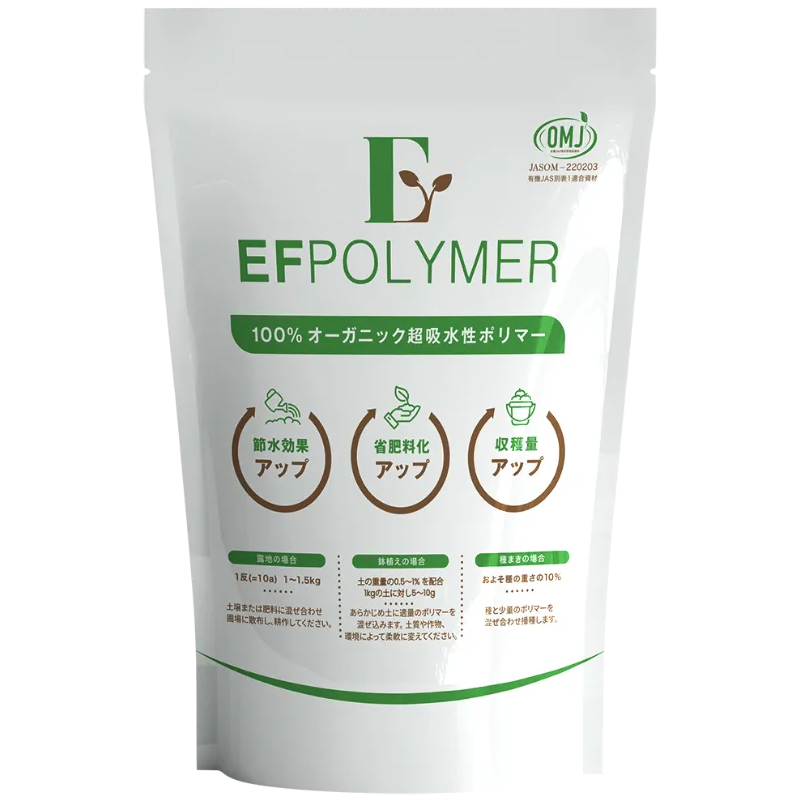
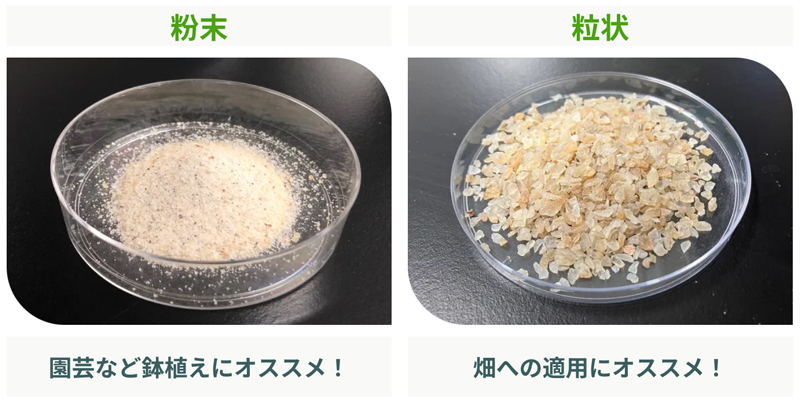
We have developed and are marketing EF Polymer (Note 1), a 100% organic superabsorbent polymer (Fig. 1), as a solution to challenges faced by farmers, such as water shortages caused by global drought and the rising cost of fertilizers. Most conventional superabsorbent polymers on the market are petroleum-based and come with several drawbacks (Note 2). In contrast, EF Polymer is made entirely from upcycled agricultural residues, such as orange peels, ensuring 100% organic composition and contributing to the development of a sustainable eco-friendly ecosystem. EF Polymer offers four key features and benefits and is available in two forms, powder and granules, depending on the application (Fig. 2).
【EF polymer Features】
- Superabsorbent: Retains about 50 times its own weight in water, making it ideal for agricultural use.
- Maintains soil health: Improves soil water retention and nutrient availability, allowing crops to gradually absorb necessary water and nutrients.
- 100% organic: Certified under the Organic JAS Material List and ECOCERT INPUT.
【Benefit of Using EF Polymers】
- 100% Biodegradable
Made from orange peels and other crop residues, EF polymer is 100% biodegradable. Its effects last for six months and it gradually decomposes into the soil over the course of about one year, leaving no harmful substances behind in the soil. - Enhanced Soil Water & Nutrient Retention
EF polymer can absorb approximately 50 times its own weight in water, making it ideal for agriculture. By retaining both water and nutrients, it helps improve the soil moisture levels and fertilizer efficiency over an extended period. - Unique Soil-Enhancing Properties of Organic Materials
As EF Polymer decomposes, it activates microorganisms, supporting the development of healthy and fertile soil. The polymer repeatedly absorbs and releases water, creating air pockets in the soil and promoting the formation of a well-structured, aerated soil aggregate. - Efficient Use of Resources for Increased Crop Yield
Improved water and nutrient retention will enhance crop growth, leading to higher yields. By optimizing soil moisture and fertilizer efficiency, EF Polymer supports sustainable agriculture and maximizes productivity.
We are also conducting demonstration tests with EF polymer in various regions worldwide.
| Demonstration Experiment Examples | Objective | Experimental Method | Results |
|---|---|---|---|
| Tomato (India) | Enhance water retention in arid soils and assess its impact on yield. | Varied the amount of polymer applied and irrigation levels. | Yields increased even with a 40% reduction in irrigation. |
| Okra (India) | Enhance water use efficiency and assess its impact on yield. | Varied the amount of polymer applied and irrigation frequency. | Yield was higher in the polymer-treated area with longer irrigation intervals (7 days) compared to the non-polymer area with shorter irrigation intervals (3 days). |
| Spring Corn (India) | Assess the impact on water and fertilizer use efficiency. | Varied the amount of polymer and fertilizer applied. | Yields increased, particularly in regions with low rainfall. |
| Cabbage Seedlings (Ibaraki, Japan) | Reduce irrigation frequency and assess the impact on crop weight. | Applied 1% and 2% EF polymer to cabbage seedlings and monitored the growth in "normal irrigation" and "reduced irrigation" zones. The growth of the seedlings was also observed after they were transplanted into the field. | In the "normal irrigation" zone, seedlings in the 1% plot increased in weight by 22%, while those in the 2% plot increased by 18%. In the "reduced irrigation" zone, seedlings in the 1% plot gained 32% in weight, while those in the 2% plot gained 28%. |
In addition to the agricultural sector, we are conducting joint research to develop environmentally friendly alternatives for products that currently use conventional superabsorbent polymers (e.g., cosmetics, hygiene products and disaster preparedness supplies). In October 2023, in collaboration with Iwatani Corporation, we announced "Cy-Cool," a biodegradable cooling agent made with EF polymer, which is now used in one of the major retailer in Japan.
Effects/Expected Benefits
EF polymer is made from agricultural residues such as orange peels nad banana peels, which would otherwise release CO2 in the process of disposal. By using this material, we can enhance yields even in water-scarce environments while also addressing waste and environmental issues. Its use in agricultural fields has the effect of improving soil water and nutrient retention, reducing water usage by approximately 40% and fertilizer consumption by 20%, as well as increasing crop yields.