Enhancing Business Continuity Management (BCM)
DISCO Corporation
| Publication date | October 28, 2021 |
|---|---|
| Sector | Natural Disasters / Coastal Areas, Human Health, Industrial and economic activities |
Company Overview

DISCO Corporation is a manufacturer and distributor of precision processing machines and precision processing tools (processing abrasives) that are essential to the semiconductor manufacturing process. With the core value of "bringing science to comfortable living through advanced Kiru, Kezuru, and Migaku technologies," we provide products worldwide in the machining process of precision cutting and grinding of materials such as IC chips and other semiconductors and electronic components.
Climate Change Impacts
The 9/11 terrorist attack in 2001 raised awareness of risk management among many companies, and in 2003, the U.S. semiconductor manufacturing industry established a supplier assessment standard called the Standardized Supplier Quality Assessment (SSQA). The requirements for disaster recovery in this standard became the trigger for us to start working on our Business Continuity Management (BCM). Initially, the only threats envisioned were "major earthquakes" and "infectious disease pandemics," but now our BCM covers a wide range of events, including natural disasters. We also recognize that a large-scale disaster or outbreak of infectious diseases could affect the functions of the head office and product production; in Ota-ku, Tokyo, where the Group's head office and R&D center are located, or in Hiroshima and Nagano prefectures, where the Group's production bases are located.
Adaptation Initiatives
In order to implement systematically consistent countermeasures, our Group has established and operates the BCM Committee, which consists of executives and is chaired by the CEO. We discuss important issues related to the Business Continuity Management System (BCMS) on a daily basis, and we have also established a sector that is specifically engaged in BCM. In 2012, the company became the first company in Japan to obtain ISO 22301:2012, the international certification standard for BCM.
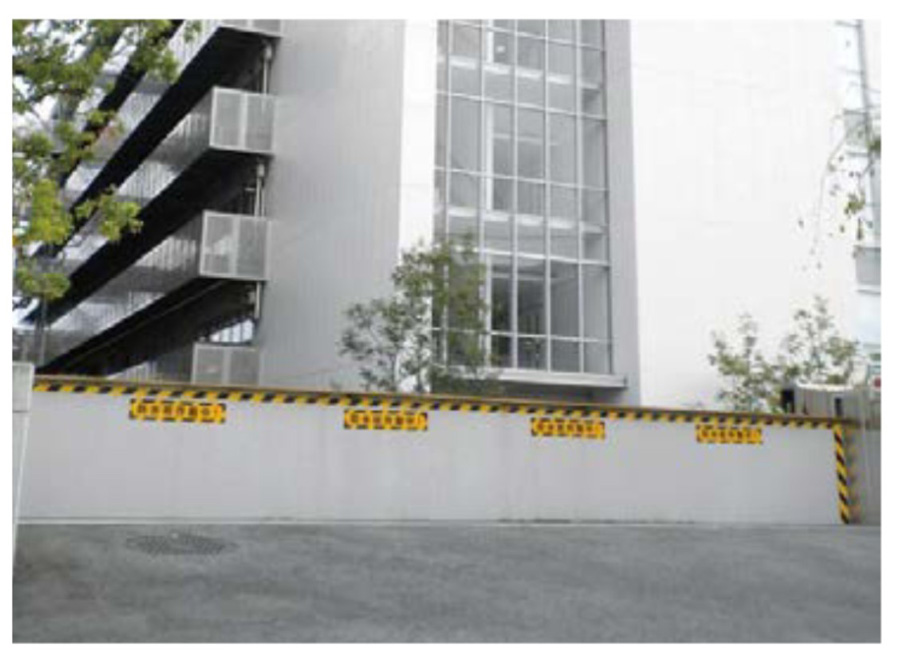
As part of our efforts to create a disaster-resistant site, the Kure Plant, which manufactures precision machining tools and is located on the coast of the Seto Inland Sea, has taken measures to prepare for possible damage from tsunamis and high tides. To prepare for unexpected emergencies such as flooding, the production, product shipping, and inspection areas are located on the upper floors, and seawalls and storm surge barriers have been built around the exterior of the plant (Figure 1).
In addition, the Nagano Works/Chino Plant was established in April 2018 to further improve the production capacity and BCM response capability. Currently, most of our main products are manufactured at the Kure and Kuwabata Plants of the Hiroshima Works, but since the two plants are only about 10 km apart, we will be able to better diversify the risk in the occurrence of a large-scale disaster by strengthening our production system at the Chino Plant. In January 2021, a new building was completed at the Chino Plant, increasing the plant's size by 7.5 times.
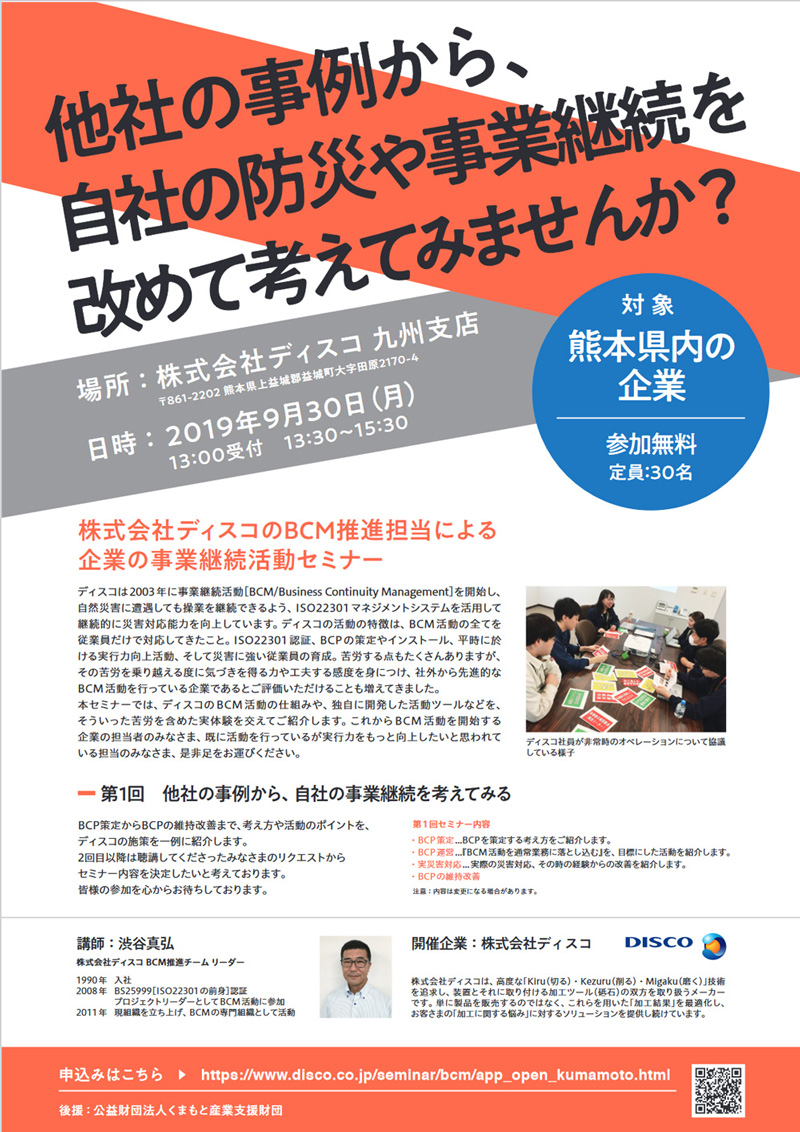
With the aim of strengthening and further developing the local economy, we have also been conducting seminars at our domestic offices to introduce the structure of BCM initiatives, originally developed activity tools, and our accumulated know-hows of BCM, including actual experiences (Figure 2).
We believe that the most important measure in BCM is “each person being able to protect themselves,” and we strive to promote employee awareness and actions to be able to protect themselves by assuming risks such as natural disasters and infectious diseases.
Effects / Expected Benefits
By regularly planning and implementing measures to prepare for large-scale natural disaster risks, we can prevent the spread of damage, contribute to the local community, and continue important business operations while placing the highest priority on securing human life and safety in the occurrence of a disaster.
The torrential rain in western Japan in July 2018 caused extensive damage to Kure city in Hiroshima Prefecture, and the Kure Plant, which manufactures our precision machining tools. The water supply was cut off from July 7 for both domestic and industrial use, along with the confusion of logistics due to the disruption of local roads. The BCM functioned even under these circumstances, so we were able to secure water for domestic use, select the best distribution route by land, sea, or air, arrange deliveries by our own delivery service, provide lunches with emergency rations, and provide daily life support to the affected employees. Through these actions, we were able to minimize the impact on our customers, with delivery delays of only one day at most.
The opening of the Chino Plant will also enable a stable supply of products in the occurrence of an emergency.