Improving Business Continuity Power through Production and Procurement
Nabtesco Corporation
| Publication date | February 14, 2022 |
|---|---|
| Sector | Natural Disasters / Coastal Areas, Industrial and economic activities |
Company Overview
Nabtesco Corporation was established in 2003 by the integration of NABCO Ltd., specializing in hydraulic and pneumatic control technology, and Teijin Seiki Co., Ltd., specializing in machining and processing technology. Based on our motion control technology that accurately moves and stops objects, we have developed many products with top market shares in Japan and abroad. Our products and technologies are used in everyday life including precision reduction gears for industrial robots, hydraulic equipment, transportation equipment, and automatic doors.
In addition, since our establishment in 2003, we have positioned environmental measures as one of the key issues in our management strategy and have been promoting environmental management. We have set a long-term goal of reducing CO₂ emissions by FY2050 to accelerate our response to climate change issues. We are also promoting various initiatives such as the realization of zero emissions and the conservation of water resources to fulfill our social responsibility through manufacturing.
Climate Change Impacts
Production activities are central to the value chain in the manufacturing industry, and the ability to maintain business continuity, especially at factories, is directly connected to securing stable profits. Through an internal risk survey, we recognized the risk of plant shutdowns due to large-scale disasters and risk of damage to our suppliers that would stop the supply of procured goods, and identified that strengthening our business continuity capability is an urgent issue.
We have also expressed our support for the recommendations made by the Task Force on Climate-Related Financial Disclosures (TCFD), and have been assessing and analyzing risks and opportunities related to climate change. Among these risks, damage to infrastructure and power instability due to wind and water disasters have been identified as physical risks that could lead to business interruption.
Adaptation Initiatives
BCP usually stands for Business Continuity Plan, but our Group has replaced "Plan" with "Power" and refers to it as "Business Continuity Power," aiming to improve the our capability to respond effectively in the occurrence of disasters.
(1) Building a highly effective BCP system through the acquisition of Resilience Certification
After the risk survey above, we initiated the update of the BCPs in our nine major factories. Recognizing that fostering responsibility and awareness is essential for each site to take the initiative in implementing BCP, we set up BCP administration at nine major plants, assigned our staff to (a) disaster prevention, (b) production, and (c) procurement, and conducted BCP drills with the assigned members including the plant manager.
In addition, in order to promote the spread of BCP within the company, we focused on the Resilience Certification, which is certified by the National Resilience Promotion Office, Cabinet Secretariat, to evaluate companies that are working on an effective BCP. We started our three-year plan in 2017 with the goal of being certified for each of our nine major factories by the end of 2020.
In order to improve the BCPs of each plant, we had the support of the Production Innovation Division from the headquarters, to share information and initiatives within the group and to create an environment that encourages positive competition. For example, one of our group companies PACRAFT Co., Ltd. had been implementing BCP initiatives for a long period of time and had been outstanding in terms of their strategy and effectiveness. They had the ability to conduct alternative production even in the event of a large-scale disaster, so we decided to share these types of precedents with other plants.
As a result of the efforts above, all nine plants were able to acquire the Resilience Certification, and BCP systems that are highly effective have been established at our major sites (Fig. 1).
(2) Efforts to improve BCP of the supply chain as a whole
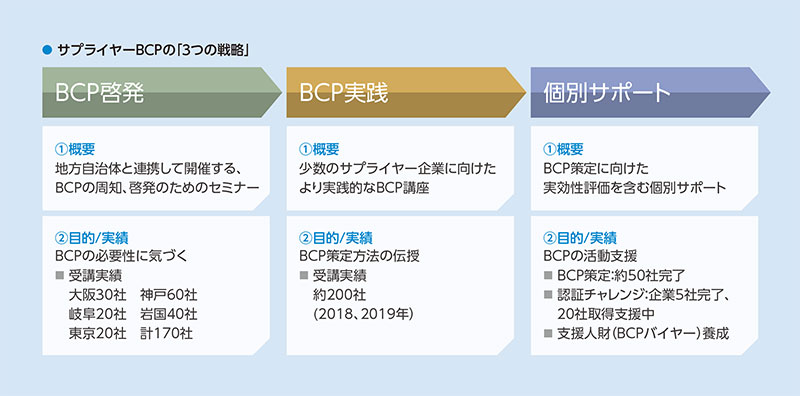
Our Group is also promoting initiatives to support the BCP of our suppliers to mitigate risks in our supply chain as a whole (Fig. 2). We held seminars to promote the awareness for BCP in Osaka, Kobe, Gifu, and Iwakuni for 400 suppliers that has potential impact on our business continuity. This was followed by more practical seminars, BCP Drafting Course and BCP Training Course, tailored to each company's stage of BCP development. For our core suppliers and ambitious suppliers, we are providing individual support for them to develop their original training and to acquire the Resilience Certification. In the past, the headquarters conducted the BCP promotion activities for suppliers. However, in order to promote the spread of BCP, it is essential for the procurement staff of each division to support BCP directly at business sites with suppliers, and therefore, we are conducting the BCP Buyer Training Course for those in charge.
Effects / Expected Benefits
As the risk of windstorms and flood disasters increases due to the worsening climate change, we have implemented highly effective BCP measures at our main sites through the activities described in (1). This has enabled us to speed up our business recovery, secure a minimum level of revenue, and continue our operations even if a major disaster were to strike the sites. By utilizing the Resilience Certification System, we were able to establish such system in a short period of time.
In addition, by identifying organizational issues in the process of BCP activities, and concentrating resources to resolve these issues on site, we have been able to improve production and procurement operations, which has led to the overall improvement in manufacturing. Through the activities described in (2), we will aim to spread our BCP initiatives throughout the supply chain to realize a robust and disaster-resistant supply chain.