Note
(Note 1) International Energy Agency (IEA) is a subsidiary body under the Organisation for Economic Co-operation and Development (OECD), established to ensure energy security, primarily focusing on oil. It serves as a counterbalance to the Organization of the Petroleum Exporting Countries (OPEC) and currently has 29 member countries.
(Note 2) "Sustainable Development Scenario" analyzes the pathway required to fully achieve the goals set under the Paris Agreement. (Source: Agency for Natural Resources and Energy, Japan – Understanding the Future of Global Energy from the IEA Report) only available in Japanese
https://www.enecho.meti.go.jp/about/special/johoteikyo/world_energy_outlook2019.html
(Note 3) "Current Policies Scenario" illustrates what would happen if countries worldwide made no changes to their existing energy policies and continued their current trajectory. (Source: Agency for Natural Resources and Energy, Japan – Understanding the Future of Global Energy from the IEA Report) only available in Japanese
https://www.enecho.meti.go.jp/about/special/johoteikyo/world_energy_outlook2019.html
(Note 4) A research paper published in 2018 that discusses future air conditioning demand, required electricity, and CO₂ emissions. (Source: Daikin – Activity Highlights)
https://www.daikin.com/csr/feature
(Note 5) Carbon Neutrality refers to the goal of achieving net-zero greenhouse gas emissions by 2050. (Source: Agency for Natural Resources and Energy, Japan – "What is Carbon Neutrality?" (Part 1)only available in Japanese
https://www.enecho.meti.go.jp/about/special/johoteikyo/carbon_neutral_01.html)
(Note 6) A scenario that assumes the continuation of past trend-based changes in energy and environmental policies. (Source: IEEJ Outlook 2021)only available in Japanese
https://eneken.ieej.or.jp/data/9171.pdf
Scenario Analysis for Disclosure Based on TCFD Framework
*This case study is published based on information as of July 2024.
DAIKIN INDUSTRIES, LTD.
| Publication date | August 5, 2024 (Posted on June 26, 2025) |
|---|---|
| Sector | Industrial and Economic Activities |
Company Overview

DAIKIN INDUSTRIES, LTD. is a global manufacturer with over 80% of its total sales coming from overseas markets and more than 80% of its group employees working overseas. Leveraging its core technologies in "air-conditioning" and "fluorochemicals", the company delivers products and services that enhance the health and comfort of people and spaces, by responding to the diverse needs arising from the unique cultures and values of each country and region.
Climate Change Impacts
According to the IEA (International Energy Agency) (Note 1), global demand for air conditioning is expected to more than triple the current level by 2050. While there are potential risks such as stricter energy regulations for air conditioning and tighter regulations on high-global-warming-potential refrigerants, it also creates opportunities to expand our group's competitive edge in environmentally friendly products and services.
Adaptation Initiatives
In May 2019, the company endorsed the recommendations of the Task Force on Climate-related Financial Disclosures (TCFD) aimed at reducing the risk of financial market instability caused by climate change. We subsequently conducted a scenario analysis to assess the risks and opportunities that climate change may pose to our business. Since 2020, we have been disclosing the findings in our sustainability report and corporate website.
The following scenarios were used in conducting the scenario analysis.
- IEA Sustainable Development Scenario (Note 2)
- IEA Base Line Scenario, Current Policies Scenario (Note 3)
- IEA The Future of Cooling (Note 4)
- IEA Net Zero by 2050 (Note 5)
- Institute of Energy Economics, Japan (IEEJ) Reference Scenario (Note 6)
The results of the latest scenario analysis are presented below. The analysis results are categorized based on the degree of temperature increase into three groups: 4°C scenario, 1.5°C scenario, and a comparison of both 4°C and 1.5°C scenarios.
| Scenario | Analysis Results |
|---|---|
| 4°C scenario with policies proceeding as they are |
|
| 1.5°C scenario with stricter national regulations due to decarbonization policies |
|
| Both 4°C and 1.5°C scenarios |
|
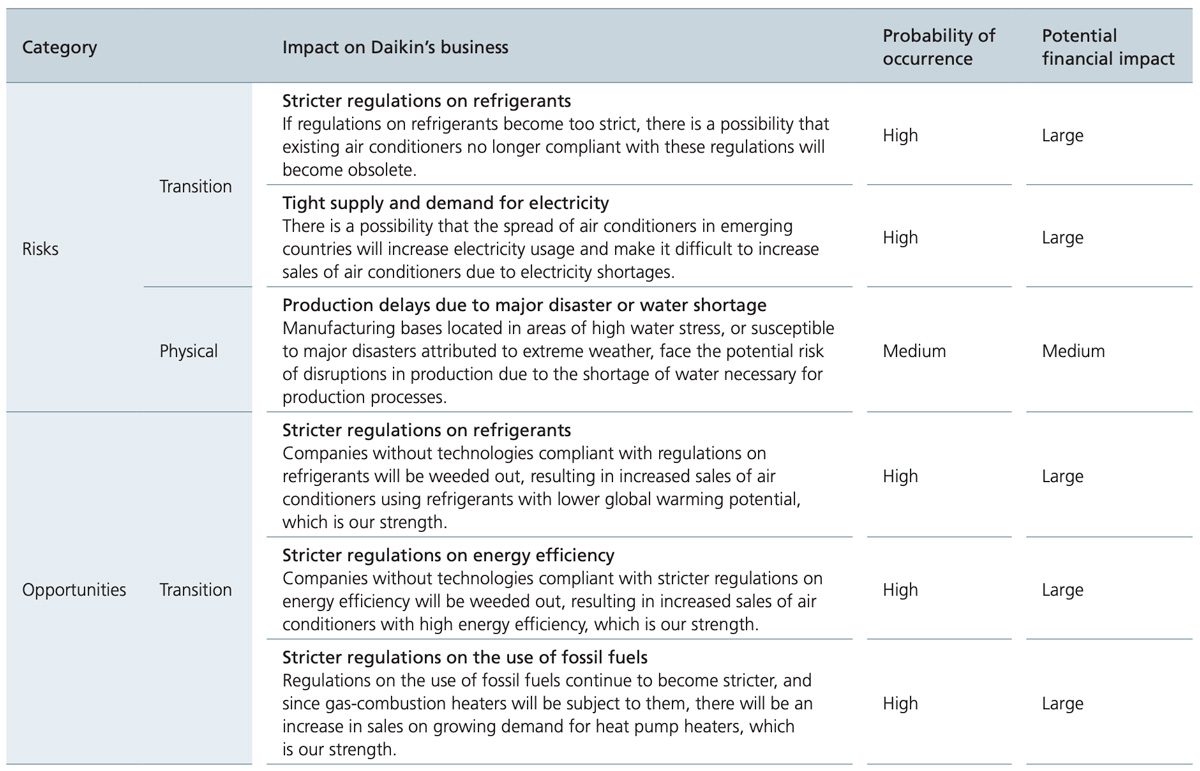
Based on the results of the scenario analysis, we classified the various external environmental changes associated with climate change into "transition risk" and "physical risk". We then assessed the financial impact on three levels: high, medium, and low to identify key risks and opportunities (Figure).
Effects/Expected Benefits
The risks and opportunities identified through scenario analysis are incorporated into the strategic management plan "FUSION" as policy directions and response measures, which are implemented by each business unit. Additionally, since the identified climate-related risks have a significant impact on our business strategy, they are integrated into our company-wide risk management process.