InterviewLocal Climate Change Adaptation CenterVol. 10 Tottori Prefecture
Please tell us about Tottori Prefecture’s unique local features and characteristics, what led to the establishment of the Local Climate Change Adaptation Center, and what its organizational structure is like.
(1)Tottori Prefecture’s unique local features and characteristics
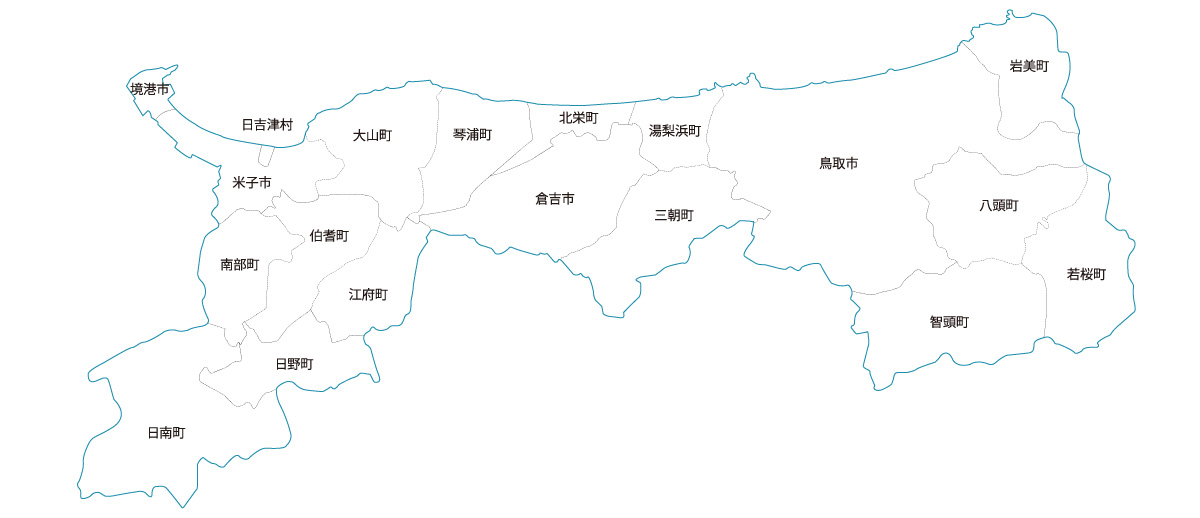
Tottori Prefecture is located in the northeastern corner of Japan’s Chugoku region that sits on the western tip of the country’s main island. The prefecture, the dimensions of which are roughly 120 km wide and 20 to 50 km long depending on the longitude, has a somewhat elongated shape from east to west (area: 3,507 km2, population: approx. 550,000, number of households: approx. 220,000). Tottori Prefecture borders the Sea of Japan and its coast is lined with white sandy beaches – including the famous Tottori Sand Dunes – and lush pine trees. In the south, the prefecture has Mount Daisen, the highest mountain in the Chugoku region, amid ranges of other Chugoku Mountains. While most of its topography is mountainous, Tottori also has plains, created in the basins of its three major rivers, where the prefecture’s core cities of Tottori, Kurayoshi, and Yonago have developed.
Tottori’s weather is relatively temperate, allowing inhabitants to enjoy mostly fair skies from spring through fall and some snowfalls in winter. The changing of the four seasons in the prefecture is a sight to behold. Tottori also historically has a relatively low incidence of typhoons and other natural disasters and has all-around good climate conditions. However, Tottori is also experiencing the impact of climate change, in the form of more strong typhoons passing by, higher incidence of cloudbursts and other natural disasters, and also more zero-precipitation days, which raises the risk of water shortage, etc.
Tottori is part of the Chugoku region in terms of administrative zoning, but it belongs to the Kinki economic zone led by Osaka as far as economy is concerned. So it naturally follows that Tottori has increasingly close ties to the Keihanshin (Kyoto-Osaka-Kobe) region in terms of bidirectional movement of people and goods across the prefectures. As for its economic composition, Tottori’s 2018 gross prefectural product was \ 1,908,000,000,000, consisting of 2.8% primary sector, 21.6% secondary sector, and 74.8% tertiary sector*1.
*1: As the above figures include taxes and tariffs levied on imports, they do not add up to 100%.
Tottori is surrounded by the clear blue Sea of Japan, lush green mountains, and abundant nature all around, where its famous 20th century pears, watermelons, and numerous other kinds of produce are grown, and fresh fishes such as opilio crab, iwagaki oyster, and sailfin sandfish are landed.
Source: Tottori prefecture website Tottori-ken no purofīru [Profile of Tottori prefecture]. Tottori-ken nōrinsuisangyō no gaiyō [Overview of agriculture, forestry, and fishery in Tottori prefecture] (2021 edition)
(2) What led to the establishment of the Climate Change Adaptation Center in Tottori Prefecture
In recent years, the effects of climate change have been manifesting across various regions of the world in the form of rising temperatures, higher frequency of heavy rains, deteriorating crop quality, changing areas of fauna and flora distribution, higher risk of hyperthermia, etc. Due to the continuous progression of global warming, the risk of extremely hot weather and rainstorms is expected to rise even further. According to a long-term trend estimation based on data observed by the Tottori Local Meteorological Office between 1943 and 2017, the average annual temperature is continuously rising by 1.8°C every 100 years.
As climate change indiscriminately affects every aspect of human activity, Tottori Prefecture has already implemented various adaptive measures so far. The prefectural government remains committed to continuously sharing information on climate change with the public through its assigned departments to minimize social and economic damage and losses and facilitate activities that aim to use climate change as an impetus for furthering the region’s status in a new direction. In March 2020, the prefecture issue its comprehensive plan entitled Tottori Prefecture Environmental Initiative Plan for the New Reiwa Era that includes the local climate change adaptation plan as described above.
This plan is designed to continuously sustain Tottori’s sound and bountiful environment while defining a framework in which various individual, communal, and economic activities will interact with one another in such a way conducive to the prefecture’s sustainable development. The plan also includes a climate change adaptation initiative that involves active facilitation of adaptive measures based on assumed climate change impacts and risks. The prefecture’s establishment of its own Local Climate Change Adaptation Center is also a part of the plan, the stated mission of which is to gather wide-ranging information on climate change and use it to raise awareness among prefectural residents and businesses and provide related education and guidance to them on the topic.*1
In accordance with such plan, Tottori has opened its Climate Change Adaptation Center that is responsible for executing various adaptive measures to address climate change, gathering diverse information related to the topic, and spearheading public awareness, education, and information campaigns for prefectural residents, businesses, and other stakeholders. This new organization is set up on the premises of the Tottori Prefectural Institute of Public Health and Environmental Sciences so that it is optimally positioned to conduct investigative research in the grand scheme of related national projects when such opportunities are presented. (The new organization is set up by the prefecture not as a separate and independent entity but as its Climate Change Adaptation Center within the structure of the prefectural government, to which operational duties concerning its mission are assigned.)
*1: The source referenced is Tottori Prefecture Environmental Initiative Plan for the New Reiwa Era (Entire Volume), pp. 51-55, which is hyperlinked from the prefecture’s webpage of the same title.
(3) Organizational structure
As the Tottori Prefectural Climate Change Adaptation Center is set up not as a separate entity but as a new arm of the prefectural government for the specified purpose of its establishment within the Tottori Prefectural Institute of Public Health and Environmental Sciences, there are no full-time employees.
Instead, we are planning on assigning the prefectural government employees that are conducting water environment research, and handling planning and coordination tasks to do investigative studies on the effects that climate change is having on our water environment, in addition to their information gathering tasks related to climate change impacts and adaptation measures, public awareness, education, and information campaigns across Tottori Prefecture, as their additional jobs. We are also considering possibly merging the organization with the Tottori Center for Climate Change Actions*2 at some point in the future.
- Secretary General of the Tottori Prefectural Climate Change Adaptation Center ⇒ Director of the Tottori Prefectural Institute of Public Health and Environmental Sciences
- Gathering and provision of information, operation of public awareness and education campaigns, etc. on climate change impacts and adaptation measures concerning Tottori Prefecture ⇒ Assistant Manager, planning and coordination staff, Zero-Carbon Society Facilitation Section
- Investigative research on the impact of climate change on the water environment ⇒ Water environment action team
*2: ECO Future Tottori (incorporated NPO with its secretariat located at Tottori University of Environmental Studies) has been selected by Tottori Prefecture pursuant to Article 24 (1) of the Act on Promotion of Global Warming Countermeasures as the center for the promotion of measures to address global warming.

Please tell us about the current activities of Tottori’s Local Climate Change Adaptation Center as well as its future plans.
As the Tottori Prefectural Climate Change Adaptation Center was just established this past April, it is not yet fully operational at this point. However, we are going to gather and analyze information and data on the effects of climate change that are reportedly starting to manifest on Tottori Prefecture, conduct related investigative research, disseminate the information and knowledge obtained from such activities, and operate public awareness and education campaigns for prefectural residents, businesses, etc. as described below.
(1) Gathering of information on the effects of climate change on Tottori Prefecture
- Gather diverse information on climate change, and operate public awareness and education campaigns, etc. in cooperation with prefectural residents, businesses, and other stakeholders as well as concerned organizations.
- Gather information from people engaged in agriculture, fishery, etc. as they might be encountering circumstances where climate change impacts are strongly felt in their daily activities.
- Gather other types of information from prefectural residents.
(2) Investigative research on the effects of climate change on the water environment and circulation in Tottori Prefecture
We are considering conducting investigative research on the topics as stated below to assess climate change impacts while focusing on the clean and abundant water environment and water circulation available in Tottori Prefecture and their benefits.
We will gain an understanding of the current status of the prefecture’s clean and abundant water environment and water circulation as described below, and predict and assess the effects of climate change.
1. The movement of water from precipitation → land → sea, and water circulation
2. The mechanism through which the process as described in 1 above creates the clean and abundant water environment and fishing grounds off the coast
(3) Coordination with the national and neighboring municipal governments
We will coordinate with the national government as well as our neighboring municipalities, etc. to examine adaptation-related issues with which various concerned parties in the region must jointly address.
Participation in the Chugoku-Shikoku Regional Council on Climate Change Adaptation
We will also participate in the following subcommittees of the aforementioned Council.
- Subcommittee on the ecosystems of mountain and forest vegetation, deer, etc.
- Subcommittee on the local industries in the areas bordering the Seto Inland Sea and the Sea of Japan
(4) Dissemination of information and knowledge and operation of public awareness and education campaigns
We will disseminate the information and knowledge obtained from the activities as described in (1) through (3) above and will also operate public awareness and education campaigns, etc.
Please tell us about any unique approach that your Local Climate Change Adaptation Center is taking to effectively coordinate with other departments of the Tottori Prefectural Government and to facilitate adaptation by the prefecture and businesses, as well as any issues, etc. you are experiencing.
As for our activities to assess the effects of climate change on Tottori Prefecture, we are planning on first gathering and disseminating information in conjunction with people engaged in agriculture and fishery and other concerned parties since we believe they are the ones feeling the severe impacts of climate change in their daily activities. So we intend to conduct our information gathering through the methods described below with the support of the agriculture, forestry, and fishery department from the prefectural government office.
- Gathering of information from those engaged in agriculture ⇒ Conduct questionnaire surveys and interviews through agriculture instructors.*
*Agriculture instructors: These are certified by Tottori Prefecture based on municipal recommendations. There are currently about 70 of them in the prefecture. They are leading various activities to promote agriculture in local communities. Their tasks include provision of training to individuals that are new to agriculture, guidance and support in the activities of farm-village youth conferences, etc., cooperation with agriculture improvement and promotion projects, suggestion on agricultural policy to municipal and prefectural governments, support to promote local agriculture, etc.
- Gathering of information from those engaged in fishery ⇒ Conduct questionnaire surveys and interviews through the Tottori Prefectural Fishery Cooperative Association.
⇒ We will build connections and professional networks in the above process so that we can rely on them when we subsequently disseminate information, operate public awareness and education campaigns, and examine adaptation measures.
In addition, we will reference the information that was previously gathered when the Tottori Prefecture Environmental Initiative Plan for the New Reiwa Era was formulated prior to the establishment of the Tottori Prefectural Climate Change Adaptation Center.
We will also involve the administrative organs of our prefectural government’s fishery department and testing and research bodies (fishery section, fisheries research institute, fish farming center) to jointly participate in the survey activities of the subcommittee on the local industries in the areas bordering the Seto Inland Sea and the Sea of Japan, which is a subsection of the Chugoku-Shikoku Regional Council on Climate Change Adaptation, of which Tottori Prefecture is a member, and to share information and coordinate activities with them.
Please tell us what motivates you to do your current work and also your outlook on the future.
Through the Tottori Prefectural Climate Change Adaptation Center’s activities, we are trying to pique people’s interest in climate change and its impacts on the prefecture as a critical issue that personally affects them, while also reminding them that Tottori is blessed to have such rich natural environment and how valuable it is to us.
As explained above, if we can stimulate prefectural residents’ interest in climate change and raise their awareness, we expect that will be conducive to the facilitation of measures to better adapt to and suppress the effects of climate change. In addition, we are hopeful that the knowledge we will obtain during our information gathering and investigative research will lead to our discovery of novel methods that can be applied to the formulation of adaptation measures.
This article was written based on the prefecture’s written response dated September 22, 2021.
(Posted on January 13, 2022)